





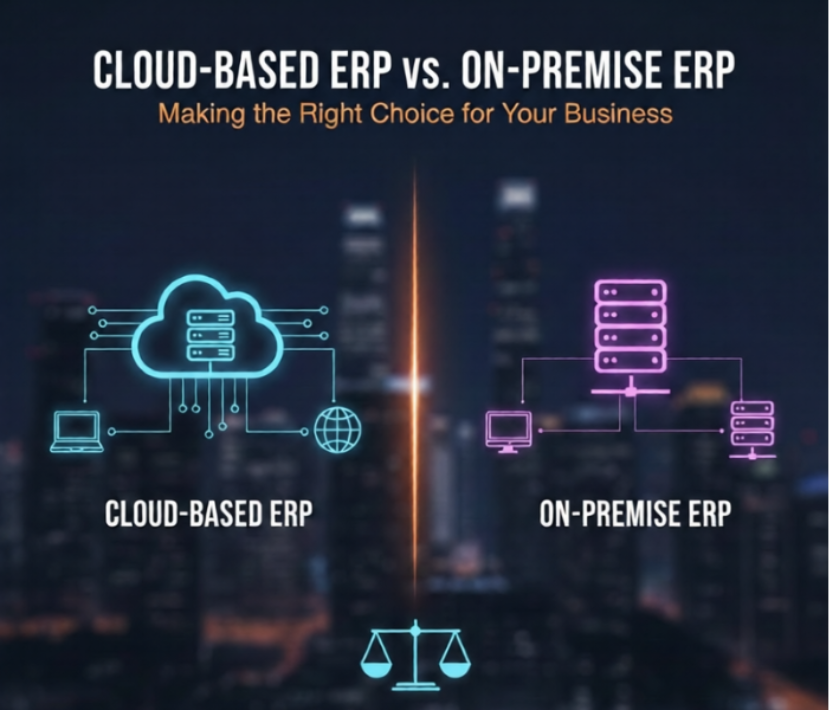
Cloud-Based ERP vs. On-Premise ERP: Making the Right Choice for Your Business
In today’s digital landscape, businesses rely on Enterprise Resource Planning (ERP) systems to streamline operations, enhance efficiency, and drive growth. However, selecting the right ERP system is a strategic decision that can impact business performance. The two primary deployment models—Cloud-Based ERP and On-Premise ERP—offer distinct advantages and challenges.
This article provides a comprehensive comparison of cloud-based and on-premise ERP solutions, helping businesses make an informed decision based on their operational needs, budget, and long-term strategy.
Understanding ERP Deployment Models
Cloud-Based ERP
A cloud-based ERP system is hosted on remote servers and accessed via the internet. The software provider manages infrastructure, updates, and security, allowing businesses to focus on core operations. Cloud ERP follows a Software-as-a-Service (SaaS) model, where businesses subscribe to the service instead of purchasing the software outright.
On-Premise ERP
An on-premise ERP system is installed on a company’s local servers and maintained by an in-house IT team. Businesses have full control over data, security, and system customization. This model involves purchasing a software license and investing in hardware, making it a capital-intensive solution.
Key Factors to Consider: Cloud ERP vs. On-Premise ERP
1. Cost Structure
- Cloud-Based ERP: Operates on a subscription-based model (monthly or annual fees), covering software, maintenance, and support. Lower initial investment makes it ideal for small and mid-sized businesses (SMBs).
- On-Premise ERP: Requires a significant upfront investment in hardware, software, and IT personnel. However, long-term costs may be lower since businesses avoid recurring subscription fees.
2. Implementation and Deployment
- Cloud-Based ERP: Faster deployment as it does not require extensive IT infrastructure. Most cloud ERP solutions can be implemented within weeks.
- On-Premise ERP: Lengthy implementation process due to software customization, hardware setup, and IT configuration, often taking months to fully deploy.
3. Scalability and Flexibility
- Cloud-Based ERP: Highly scalable; businesses can easily add users, modules, or storage as needed. Best suited for rapidly growing companies.
- On-Premise ERP: Limited scalability; expanding requires additional hardware and infrastructure, which can be time-consuming and costly.
4. Data Security and Compliance
- Cloud-Based ERP: Security and compliance are managed by the ERP provider. Top-tier cloud vendors implement data encryption, multi-factor authentication, and continuous monitoring to ensure protection. However, some industries with strict regulatory requirements may have concerns over third-party data hosting.
- On-Premise ERP: Provides complete control over data security and compliance. Ideal for businesses in highly regulated industries such as finance, healthcare, and government, where data privacy is a top priority.
5. Maintenance and Upgrades
- Cloud-Based ERP: Automatic updates and security patches are handled by the provider, reducing the burden on in-house IT teams.
- On-Premise ERP: Businesses are responsible for maintenance, upgrades, and troubleshooting, requiring dedicated IT personnel.
6. Accessibility and Remote Work Support
- Cloud-Based ERP: Accessible from anywhere via an internet connection, enabling remote work and multi-location operations.
- On-Premise ERP: Access is typically restricted to the corporate network, requiring VPNs or remote desktop solutions for external access.
7. Customization and Integration
- Cloud-Based ERP: Offers standard configurations but may have limited customization compared to on-premise solutions. Integrations with third-party applications are available but may require additional API development.
- On-Premise ERP: Fully customizable to meet unique business requirements. Companies can modify the system architecture, workflows, and integrations as needed.
When to Choose Cloud-Based ERP
A cloud-based ERP solution is ideal for businesses that:
✔ Need quick deployment with minimal IT infrastructure.
✔ Prefer a subscription-based pricing model to reduce capital expenditure.
✔ Require remote accessibility for global teams or multiple locations.
✔ Seek automatic updates and maintenance without IT intervention.
✔ Operate in industries where scalability and agility are essential (e.g., technology startups, e-commerce, and service-based businesses).
Example: A growing e-commerce business with multiple warehouses may opt for cloud ERP to streamline inventory management, enhance customer experience, and enable real-time tracking.
When to Choose On-Premise ERP
An on-premise ERP solution is recommended for businesses that:
✔ Require full control over data security and compliance due to regulatory requirements.
✔ Need extensive customization tailored to specific industry needs.
✔ Operate in sectors with complex supply chains, such as manufacturing, automotive, and healthcare.
✔ Have an established IT team to manage system maintenance and upgrades.
✔ Prefer a one-time investment rather than ongoing subscription fees.
Example: A large manufacturing company with strict production workflows, compliance regulations, and proprietary data may choose on-premise ERP to maintain operational control and security.
Final Verdict: Which ERP Model is Right for Your Business?
The decision between cloud-based ERP and on-premise ERP depends on your organization’s size, budget, IT capabilities, and business objectives.
FactorCloud-Based ERPOn-Premise ERPInitial CostLower (Subscription-Based)High (One-Time Investment)Deployment SpeedFastSlowScalabilityHighLimitedCustomizationModerateExtensiveSecurity ControlManaged by ProviderFully Controlled by BusinessMaintenanceHandled by VendorRequires In-House ITAccessibilityRemote AccessOn-Site AccessBest ForSMBs, Startups, Remote TeamsLarge Enterprises, Regulated Industries
For most small to medium-sized businesses, cloud ERP provides a cost-effective, flexible, and easily deployable solution. However, large enterprises that require high levels of customization, data security, and compliance may benefit more from on-premise ERP.
Unlock the Full Potential of ERP with TechInfini Solutions
Choosing the right ERP system is a strategic decision that can shape the future of your business. At TechInfini Solutions, we specialize in ERP implementation, customization, and integration, ensuring a seamless transition tailored to your industry needs.
Whether you are considering cloud-based ERP for agility or on-premise ERP for complete control, our experts are here to guide you every step of the way.
Contact TechInfini Solutions today to discuss your ERP requirements and take your business to the next level!